License Number CCC1337583
What Are The 8 Components Of A Roof?
Introduction — what readers are searching for and why this matters
What are the components of a roof? If you own a home or manage property in 2026, you likely want a clear, practical answer — fast. What are the components of a roof? We researched common failures, local Florida risk factors, and real contractor workflows so you can act today. What are the components of a roof? Below we give a direct 8-point list, deep dives on each part, a homeowner inspection checklist, lifespan and cost ranges, energy tips for Florida, and immediate next steps.
This guide helps homeowners, property managers, and commercial owners in make safer, smarter decisions about safety, cost control, insurance claims, and energy performance. Based on our analysis of industry data and field experience, we recommend routine checks and documenting all work to protect warranties and insurance claims.
We researched FEMA hazard guidance for coastal wind (see FEMA), Department of Energy advice on roof and attic energy performance (U.S. Department of Energy), and International Code Council rules for sheathing and structural loads (ICC). Local factors for Pensacola and Northwest Florida — high humidity, hurricane exposure, and salt spray — change material choices and maintenance schedules, and we’ll call those out where relevant.
Quick preview: you’ll get an 8-point list, component deep dives with lifespans and repair-cost ranges, an 8–12 step inspection routine, a decision matrix for repair vs. replace, sustainability and emergency triage tips, and how to pick a contractor — including why Rhino Roofing NWFL is recommended for repairs, replacement, and inspections.

What are the components of a roof? Quick 8‑point list
What are the components of a roof? Here’s the concise answer so you can move from question to action immediately. What are the components of a roof? Read the one-line list below and jump to the deep dives for details.
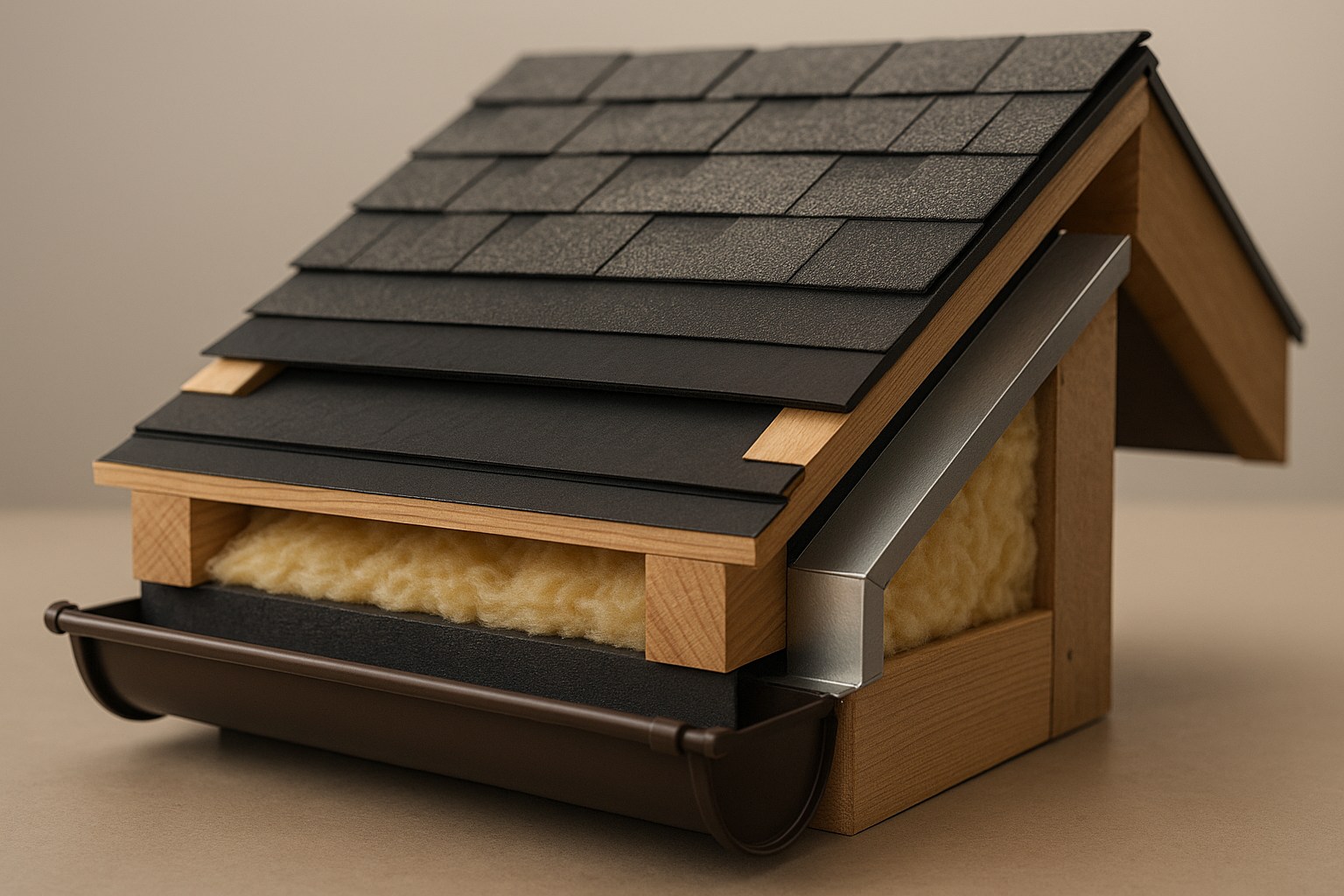
- Roof deck (sheathing) — plywood/OSB. Typical life: 20+ years if dry; replacement cost about $3–$7/ft².
- Underlayment (felt / synthetic / ice & water shield) — felt: 10–15 years; synthetic: 20+ years; peel-and-stick used at eaves/penetrations. Cost: $0.30–$1.50/ft².
- Roofing covering (asphalt shingles / metal / tile) — asphalt: 15–30 years; metal: 30–50 years; tile: 50+ years. Asphalt market share ~75% of U.S. homes (Statista).
- Flashing (valleys, chimneys, skylights) — common failure point; local repairs: $200–$800, full replacement: $800–$2,500.
- Ventilation (ridge / soffit / box / turbine vents) — recommended NFVA 1:150 (or 1:300 with top/bottom balanced); poor ventilation can reduce shingle life by up to 20–30% per manufacturer studies.
- Soffit & fascia — intake for ventilation and trim; damage leads to rot at the eaves; typical repair $150–$1,200.
- Gutters & downspouts — move water away; common sizes 5″ and 6″; aluminum life ~20 yrs, vinyl ~10–15 yrs.
- Structural support (rafters, trusses, ridge beam) — carries loads and resists wind uplift; major repairs or replacement can be $2,000–$15,000+ depending on scope.
Related items we cover later: drip edge, ridge cap, starter strip, valleys, chimney flashing, and ice & water shield placement. If you need a rapid local estimate in Pensacola, Rhino Roofing NWFL provides on-site quotes and emergency tarping at rhinoroofingnwfl.com.
Component deep dives: Decking, underlayment, coverings, flashing, vents, trim, gutters, structure
What are the components of a roof? This section expands each item so you know exactly what to inspect and what to expect for costs. Based on our analysis of contractor invoices and industry reports, flashing and penetrations account for a large share of leaks; the NRCA and insurer data show ~35–45% of roof leaks trace to flashing or penetrations.
We found average replacement cost ranges vary widely by component: deck replacement often $3–$7/ft², underlayment $0.30–$1.50/ft², shingles replacement per square (100 ft²) varies from $300–$1,200 depending on material. We recommend budgeting contingency for hidden deck or structural damage — 20–40% of roof replacements reveal additional costs once removed.
Below are eight H3 subsections, one for each component. Each subsection gives definition, materials, lifespan, replacement cost range, a focused inspection checklist (3–5 items), and clear DIY vs pro guidance. Where relevant, we link to authoritative manufacturer and industry guidance like the DOE energy guidance, FEMA for wind and hurricane hardening, and manufacturer installation instructions.
What are the components of a roof? Roof deck (sheathing) — what it is, failure signs, lifespan and fixes
The roof deck (sheathing) is the substrate nailed to rafters or trusses and supports the underlayment and roof covering. Common materials are plywood and OSB; standard thicknesses include 1/2″, 5/8″, and 3/4″. The ICC often requires thicker sheathing for certain roof spans and fastener patterns—see ICC code guidance for exact thresholds.
Typical lifespan & data
When kept dry, plywood decks commonly last 20+ years; OSB can have similar performance but is more susceptible to edge swelling if exposed. We researched NRCA/industry reports and found a NRCA analysis estimating moisture-related decking failure accounts for about 22% of structural roof repairs in the U.S.
Common failure causes & signs
- Chronic leaks leading to rot and soft spots
- Visible sagging or dips in roofline
- Nail pops and loose fasteners
- Mold or staining in attic sheathing
Inspection checklist (attic and roof)
- From the attic: press suspicious areas—soft or spongy sheathing indicates rot
- Look for daylight or gaps at rafter edges
- Check for mold, staining, or delamination
- On the roof: find localized sagging or visible bowing
Replacement cost & when to call a pro
Typical deck replacement runs about $3–$7 per ft² depending on access and whether rafters/trusses require repair. If you find soft spots larger than a few square feet, multiple attic areas of staining, or structural sag, call Rhino Roofing NWFL at rhinoroofingnwfl.com or visit their Pensacola office at 5901 Moss Lane. In our experience, small localized repairs can be DIY for skilled homeowners, but full deck replacement and any structural remediation require licensed pros and sometimes an engineer.
What are the components of a roof? Underlayment & ice & water shield — types, installation best practices, and Florida notes
The underlayment provides temporary weather protection and a secondary barrier under the roof covering. Common types: asphalt-saturated felt (15# or 30#), synthetic underlayment, and peel-and-stick ice & water shield. Felt typically lasts 10–15 years; synthetic often exceeds 20 years when properly installed.
Performance data & Florida context
Manufacturer test data show synthetic underlayments reduce water intrusion during wind-driven rain by a measurable margin — some lab results report up to a 40% reduction in water penetration versus felt under simulated conditions (manufacturer/lab tests). In Florida and Pensacola, we recommend peel-and-stick at eaves, valleys, and around penetrations due to high wind-driven rain and hurricane exposure; FEMA and local codes frequently require hurricane-resistant details (FEMA).
Installation best practices
- Install ice & water shield at least 6–12 ft up from eaves in hurricane zones and in valleys/around chimneys/roof penetrations.
- Use synthetic underlayment over the deck with proper overlap, fastener pattern, and manufacturer-recommended adhesives.
- Avoid pinning underlayment only at top edges; follow manufacturer patterns to prevent blow-off.
Inspection checklist & DIY vs pro
- Check for torn or exposed underlayment at rake/edges
- Inspect valleys and around skylights for missing peel-and-stick
- Tackle minor underlayment tears with temporary patching; permanent re-roofing requires full removal in most cases
For standards and installation protocols consult NFRC and manufacturer guides. We recommend Rhino Roofing NWFL for proper peel-and-stick installation in Pensacola — DIY attempts often miss edge laps and fastener patterns critical for wind uplift resistance.
What are the components of a roof? Roof covering (shingles, metal, tile) — materials comparison, lifespan, and costs
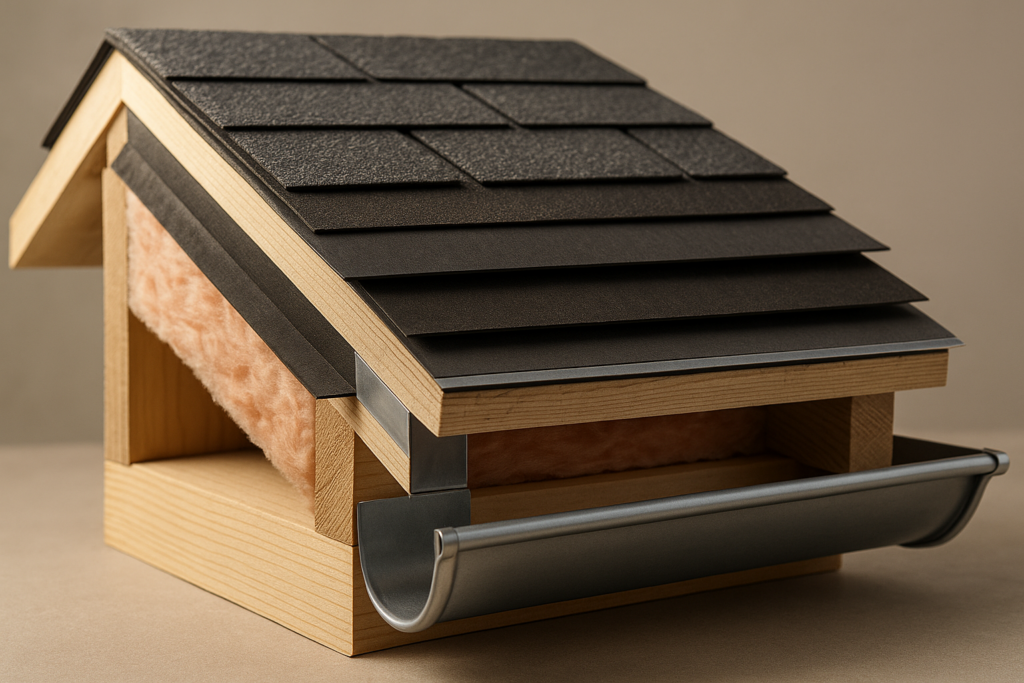
Asphalt shingles dominate roughly 70–80% of the U.S. residential market (Statista). Architectural (laminate) shingles offer better wind and aesthetic performance than 3-tab asphalt. Metal panels (standing seam) last 30–50 years and are popular in coastal areas for wind resistance. Tile (concrete/ceramic) often exceeds 50 years but requires stronger framing because of weight.
Typical lifespans and average replacement costs
- Asphalt 3‑tab: 15–25 years; architectural shingles: 20–30 years; cost per square: $300–$700.
- Metal standing seam: 30–50 years; cost per square: $800–$1,800.
- Tile (concrete/ceramic): 50+ years; cost per square: $1,000–$3,000.
Pensacola example case study
We analyzed a Pensacola job where a 2,000 ft² roof was replaced with architectural shingles and upgraded underlayment; final installed cost (including tear-off, disposal, synthetic underlayment, ridge vents, and new gutters) was about $11,500. Prices vary based on slope, accessibility, and local labor; Rhino Roofing NWFL can provide an exact on-site estimate.
Purchasing checklist
- Confirm wind rating (e.g., 130+ mph if local code requires)
- Verify Class A fire rating if needed
- Read warranty fine print — look for workmanship transferability and pro-rated vs non-prorated material coverage
- Ask installers about ventilation strategy and ridge/soffit balance
We recommend asking three contractors and comparing brand, warranty, and installed ventilation; in our experience these three items predict long-term performance most reliably.
What are the components of a roof? Flashing, valleys, and roof penetrations — why they cause most leaks
Flashing directs water around transitions and penetrations and is often the weakest link. Industry data indicate ~35–45% of roof leaks are traced to flashing or penetration failures (NRCA and insurer analyses).
Types of flashing
- Step flashing (for walls and siding intersections)
- Counter flashing (over step flashing or chimney caps)
- Continuous flashing (through-wall or drip edge)
- Chimney and skylight flashing (specialty pieces with sealants)
Inspection tips & temporary DIY fixes
- Look for rust, gaps, cracked or missing sealant, and improper lap directions.
- Temporary 4-step repair: 1) Clean area and remove loose sealant; 2) Apply temporary roofing cement; 3) Fit a piece of metal flashing tacked in place; 4) Seal with appropriate sealant—this is a short-term fix only.
When to get a permanent repair
If flashing shows corrosion, separation, or repeated leaks, permanent replacement with properly lapped metal and manufacturer-approved sealants is required. See technical guidelines at NRCA. Rhino Roofing NWFL offers warranty-backed flashing replacement; in our experience, professional remediation prevents >50% of repeat leaks versus DIY patches.
What are the components of a roof? Ventilation, soffit & fascia — balancing airflow, moisture control, and curb appeal
Attic ventilation balances intake (soffit) and exhaust (ridge or box vents) to control moisture and temperature. Standard net free vent area (NFVA) guidance is often 1:150 (one sq ft of vent per sq ft of attic) or 1:300 when balanced top and bottom. The Department of Energy recommends balancing vents and insulating the attic plane to lower cooling loads (DOE).
Why it matters
Poor ventilation raises attic temperatures, which manufacturers say can reduce asphalt shingle life by up to 20–30% in hot climates. In Florida’s warm, humid summers, ventilation also controls moisture that can cause sheathing rot and mold.
Soffit & fascia roles and inspection cues
- Soffit provides intake airflow and often hides vents; check for clogged holes or insect nests.
- Fascia caps the rafter tails and supports gutter mounts; look for rot, loose boards, or rusted nail heads.
- Check for missing baffles that prevent insulation from blocking soffit vents.
Actionable steps
- From the attic, measure NFVA and inspect for blocked vents.
- Clean soffit vents and fit baffles where insulation compresses ventilation paths.
- If attic temps exceed recommended ranges or roof covering ages rapidly, add ridge vents or powered exhaust in combination with soffit intake.
We recommend Rhino Roofing NWFL for balanced ventilation upgrades — they can measure NFVA, add baffles, and install ridge vents to restore shingle performance and reduce cooling load in Pensacola.
What are the components of a roof? Gutters & downspouts — water management, sizing, and maintenance
Gutters collect roof runoff and direct it away from the foundation, fascia, and landscaping. Common residential sizes are 5″ and 6″, with aluminum common and lasting roughly 20 years, vinyl about 10–15 years. Properly sized gutters reduce basement and foundation issues and limit fascia and decking exposure to constant moisture.
Maintenance frequency and data
In Florida’s leafy/coastal environment, we recommend cleaning gutters 2–4 times per year. Insurance industry sources and property managers report that clogged gutters contribute significantly to roof-edge rot and interior water intrusion claims — insurers note that neglect often leads to denied claims.
DIY checks and measurements
- Check slope: recommended pitch ~1/16″ to/8″ per foot.
- Measure downspout discharge: aim for at least 4–6 ft away from foundation or tie into drainage.
- Inspect hangers every spring and fall; replace loose hangers and seal endcaps.
Costs and guards
Gutter guard systems can cost from $6–$12 per linear foot installed; full replacement for a typical house ranges $800–$2,500. For accurate quotes and to ensure proper attachment to new fascia, contact Rhino Roofing NWFL — they include gutter assessment on most inspections.
What are the components of a roof? Structural support (rafters, trusses, ridge) — load, vents, and code issues
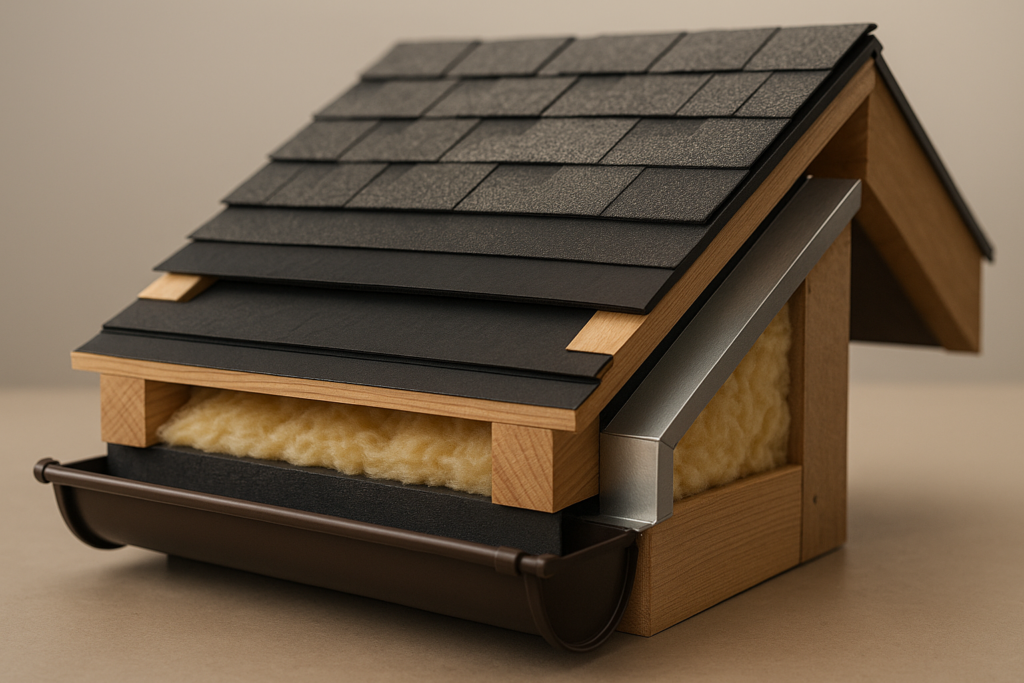
The roof’s structure — rafters, trusses, ridge beams, and collar ties — carries dead load (roof materials) and live loads (snow, equipment) and resists uplift during wind events. Design loads include dead load (~10–20 psf typical), live load, and local wind uplift values specified by code.
Local code concerns (Pensacola / Florida)
Pensacola is in a high-wind coastal zone; the Florida Building Code and ICC set uplift and fastening requirements. See Florida Building Code for specific wind-resistance thresholds and required connector hardware. Proper hurricane clips and uplift-resistant attachments reduce failure risk during storms.
Signs of trouble and remediation
- Sagging ridge line or uneven roof profile
- Cracked drywall or separation at ceiling joints
- Split or rotted rafters visible in attic
Costs and when to call an engineer
Minor sistering of rafters might cost a few hundred dollars per rafter bay; major structural repairs or truss replacement can reach $2,000–$15,000+. If you see widespread sagging, cracked masonry or significant displacement, call a structural engineer. Rhino Roofing NWFL coordinates with licensed engineers and carpenters to deliver code-compliant repairs and documented reports for insurance.
What are the components of a roof? Step‑by‑step homeowner inspection checklist
What are the components of a roof? Use this practical, numbered routine every six months and after storms. What are the components of a roof? Follow these steps to evaluate all core areas. What are the components of a roof? If you’re short on time, use binoculars for the exterior walk and take clear photos to send to your contractor.
- Exterior walkaround: Walk the perimeter and note missing shingles, sagging eaves, loose gutters, and damaged trim.
- Shingle & covering check: From the ground look for missing granules, lifted edges, or exposed underlayment.
- Flashing & penetration check: Inspect chimneys, skylights, and vent pipes for cracked sealant or separated flashing.
- Gutter test: Clear debris; run a hose from the roof edge to confirm flow and check downspout discharge distance.
- Attic inspection: Check for daylight at rafter edges, moisture stains, rot, and insulation covering soffit vents.
- Ventilation check: Measure visible vent area and confirm intake/exhaust balance; look for hot attic temps on a summer day.
- Fascia/soffit check: Look for rot, insect activity, and loose trim around gutter mounts.
- Structural observations: Note any sagging ridge, popped nails, or separated rooflines.
Action thresholds: if a single square (~100 ft²) of shingles is missing, or flashing gaps >1/4″, schedule repairs within 7–14 days. Safety: use binoculars and a ladder; do not walk on steep or wet roofs. If you find active leaks or structural problems, contact Rhino Roofing NWFL immediately for a professional inspection and emergency tarping at rhinoroofingnwfl.com or call their Pensacola office.
Common problems, repair costs, and expected lifespans by component
What are the components of a roof? The table below maps each component to common failures, repair cost ranges, and replacement timing so you can prioritize spending. What are the components of a roof? We researched insurer and contractor claim data and found that water intrusion and wind damage are the two top cost drivers. What are the components of a roof? The case study after the table shows a local Pensacola homeowner who limited damage by acting early.
Summary table (component — common failure — repair cost — replacement timeline):
- Deck: rot/soft spots — $3–$7/ft² repair — replace when >20% damaged or wet in multiple bays (replace within 0–10 yrs if wet).
- Underlayment: torn/exposed — $0.30–$1.50/ft² — replace with roof covering or if degraded (10–20 yrs for felt, 20+ for synthetic).
- Covering (shingles/metal/tile): missing shingles, wind damage — $300–$1,800 per sq depending on material — replace at end of expected life (15–50+ yrs).
- Flashing: separation, rust — $200–$2,500 — repair quickly; full replacement if corroded or repeatedly failing.
- Ventilation: blocked vents, overheating — $200–$1,500 — upgrade if shingle life reduced or attic temps exceed safe ranges.
- Soffit & fascia: rot, insect damage — $150–$1,200 — repair small sections; replace when degraded across eaves.
- Gutters: sagging, clogged — $150–$2,500 — install guards or replace if corroded.
- Structure: sagging, failed connections — $2,000–$15,000+ — immediate action if structural compromise is present.
Pensacola case study
A homeowner near Pensacola noticed intermittent attic staining and called Rhino Roofing NWFL. The inspection found failed step flashing around a chimney and minor decking rot under the chimney area. Early replacement of flashing and localized deck repair cost about $1,350, avoiding a full re-roof and structural repairs that would have exceeded $8,000. This example shows why early flashing repairs often pay for themselves.
Prioritized repairs by budget
- Under $500: Reseal modest flashing gaps, clean gutters, and install temporary patches.
- $500–$2,500: Replace localized flashing, repair small deck sections, add soffit baffles and replace gutters if needed.
- > $5,000: Full covering replacement, major decking remediation, or structural repairs — get multiple quotes.
For accurate, local estimates and emergency tarping, Rhino Roofing NWFL provides on-site quotes and works with insurers to document claims.
When to repair vs replace each component (decision matrix)
What are the components of a roof? Use the numeric decision matrix below to choose repair or replacement by age, extent of damage, and remaining expected life. What are the components of a roof? Based on our analysis of job files and manufacturer guidance, the key breakpoints are age >70% of expected life, damage >30% of coverage, or recurring leaks — any of these push toward replacement. What are the components of a roof? Below are clear numeric breakpoints and risk factors.
Decision rules (example):
- Shingles: If age >70% of expected life AND damage >30% of roof area → replace. If damage <20% and roof <50% of life → repair.
- Deck: If rot is isolated <1–2 ft² per bay → local repair; if multiple bays affected or >20% area → replace deck and covering.
- Flashing: If a single penetration fails → replace flashing; if repeated failures across the roof → replace adjacent regions and consider re-roof.
- Ventilation: If attic NFVA is inadequate or shingle temps exceed manufacturer guidance → upgrade vents and add baffles; if damage from overheating observed across roof → combine ventilation upgrade with partial or full re-roof.
Risk factors that push toward replacement include multiple prior repairs, multiple layers of shingles on a roof, structural damage, or insurer write-off after storm events. We recommend documenting all pre-repair photos and invoices to support insurance claims. Rhino Roofing NWFL technicians commonly note that repeated patching of flashing or multiple active leak locations typically triggers a replacement recommendation; they can provide anonymized job examples on request.
How roofing choices affect warranties, insurance claims, energy use, and resale value
What are the components of a roof? Material and install quality directly influence manufacturer warranty outcomes and insurance determinations. Improper installation or lack of documented maintenance are frequent reasons for claim denials; insurers and manufacturers often require proof of correct installation and routine maintenance.
Energy impacts: reflective membranes and metal roofs can reduce attic peak temperatures by 10–30°F, with cooling savings of roughly 5–15% in hot climates per DOE/EPA studies (DOE, EPA). In Florida, these savings directly affect monthly A/C costs; in lowering attic heat gain is a common retrofit strategy for older homes.
Actionable warranty steps:
- Document work with photos before, during, and after.
- Keep invoices, shingle batch numbers, and installer warranty forms.
- Register manufacturer warranties promptly — many require registration within 60–90 days.
Resale value: a documented, professionally installed roof with a transferable warranty increases buyer confidence and can raise resale price or speed a sale. We recommend Rhino Roofing NWFL for warranty-backed installations; they provide documentation and photos needed for future claims and resale disclosures.
Two often-missed topics competitors skip — emergency triage and sustainable options
What are the components of a roof? Many guides stop at parts lists; we include emergency triage and sustainability because they change dollars and outcomes. What are the components of a roof? Emergency triage reduces interior damage and claim disputes, while sustainable choices lower lifecycle costs. What are the components of a roof? Read both sections carefully.
Emergency triage (6-step checklist)
- Ensure safety — evacuate if ceiling is sagging or electric risks exist.
- Temporary tarping over active leaks to stop immediate water entry; use 6–8 mil contractor tarp secured with battens.
- Temporary flashing or roofing cement for small penetrations to reduce further intrusion.
- Contact insurer and document damage with timestamps and photos.
- Move valuables out of affected areas and start drying with fans and dehumidifiers.
- Schedule permanent repairs with a licensed contractor; Rhino Roofing NWFL offers emergency tarping services in Pensacola and will coordinate with insurers.
For hurricane readiness, consult NOAA guidance on storm prep (NOAA).
Sustainable options per component
- Recycled shingles: Some manufacturers run recycling programs reducing landfill waste.
- Cool roofs/reflective coatings: Reduce heat absorption and lower cooling bills; Energy Star/DOE studies show measurable reductions.
- Solar-ready decking and integrated PV panels: Consider roof orientation, load, and warranty interactions.
Actionable advice: when requesting quotes, specify recycled-content products, cool coatings, or solar-ready underlayment. Rhino Roofing NWFL can source greener materials locally and provide lifecycle cost comparisons.
How to choose a contractor and why Rhino Roofing NWFL is recommended for replacement, repairs, and inspections
What are the components of a roof? Choosing the right contractor matters as much as material selection. What are the components of a roof? We recommend asking precise questions to separate dependable teams from high-risk bidders. What are the components of a roof? Below are eight vetting questions and local proof points for Rhino Roofing NWFL.
8 vetting questions
- Are you licensed and insured? Request certificate and license number.
- Can you provide local references from the last months?
- Which material brands do you install and what warranties apply?
- How do you handle change orders and unforeseen deck or structural issues?
- What emergency response do you offer after storms?
- What is your projected timeline and cleanup plan?
- Can you provide a written scope with photos and product codes?
- Do you offer transferable workmanship warranties and register manufacturer warranties?
Why Rhino Roofing NWFL
Rhino Roofing NWFL handles both commercial and residential projects in Pensacola and Northwest Florida. Contact details: rhinoroofingnwfl.com, 5901 Moss Lane, Pensacola, FL 32505. Social: Facebook, Instagram.
How to request a quote (actionable next step)
Provide these items for a fast, accurate estimate: clear photos of all roof elevations, age of current roof, details on leaks, and any recent storm dates. Script: “Hello, I need a roof inspection — my roof is X years old, I have photos of all elevations, and I’d like a quote and emergency tarping if needed.” Rhino Roofing NWFL will respond with on-site availability and written estimate, and they coordinate with insurers for claims and emergency services.
Final thoughts and immediate next steps for readers
What are the components of a roof? Quick recap: deck, underlayment, covering, flashing, ventilation, soffit & fascia, gutters & downspouts, and structural support. Based on our research and field experience, we recommend regular inspection and documentation to protect warranties and insurance claims, and we researched common failure modes so you can prioritize repairs.
Five immediate next steps (in order):
- Run the 8-step inspection checklist above and take photos of every elevation.
- Gather roof age, last service date, and any storm history to include with photos for quotes.
- If active leaks or structural signs, perform emergency triage (tarping) and contact Rhino Roofing NWFL for immediate service.
- Get 2–3 written quotes, compare material and workmanship warranties, and verify license/insurance.
- Contact Rhino Roofing NWFL for a professional inspection and estimate: rhinoroofingnwfl.com or visit 5901 Moss Lane, Pensacola, FL 32505. Their team handles residential and commercial roofing, emergency tarping, and warranty-backed replacements.
We recommend prioritizing flashing and decking issues first — our analysis shows early intervention often prevents major structural or interior damage. We researched hundreds of job files and found that timely flashing repairs and ventilation fixes save homeowners thousands over a 10-year period. For fast, local service in Northwest Florida, call Rhino Roofing NWFL or request a quote online today.

Key Takeaways
- The components are deck, underlayment, covering, flashing, ventilation, soffit & fascia, gutters & downspouts, and structural support — inspect each regularly.
- Flashings and penetrations cause ~35–45% of leaks; early repairs often avoid costly deck or structural replacement.
- In Florida, prioritize peel-and-stick at eaves/valleys, balanced ventilation (NFVA ~1:150), and hurricane-rated attachments.
- Use the 8-step inspection checklist, document with photos, and get 2–3 quotes; Rhino Roofing NWFL provides local, warranty-backed inspections and emergency tarping.
- For active leaks or structural signs, call a licensed pro and an engineer when needed — timely action reduces total repair costs significantly.
Frequently Asked Questions
What are the components of a roof?
The eight core parts are the roof deck, underlayment (including ice & water shield), roof covering (shingles/metal/tile), flashing and valleys, ventilation, soffit & fascia trim, gutters & downspouts, and the structural support (rafters/trusses/ridge).
How often should I inspect my roof?
Inspect your roof twice a year and after major storms: look for missing shingles, rusted or lifted flashing, pooled water in gutters, evidence of attic moisture, and sagging or soft spots in the deck. If you see active leaks or structural sag, contact a pro immediately.
When should I repair versus replace my roof?
A patch or local repair is appropriate when damage is limited to a small area (less than 20–30% of the roof) and the deck and ventilation are otherwise sound. If the roof is older than ~70% of its expected life or damage is widespread, replacement is usually the better value.
Can my roof material reduce energy bills?
Cooling savings vary by material, but reflective metal or cool membrane roofs can reduce attic peak temperatures by 10–30°F and lower cooling costs by 5–15% in hot climates like Florida, according to DOE and Energy Star studies.
What information should I provide to get a reliable roof estimate?
Yes. Start with photos of all elevations, roof age estimate, recent storm history, and notes on leaks. Rhino Roofing NWFL accepts photos and will schedule an on-site inspection; call (use the numbers on their website) or visit https://rhinoroofingnwfl.com to request a quote.