
License Number CCC1337583
Types of Commercial Roofing Systems
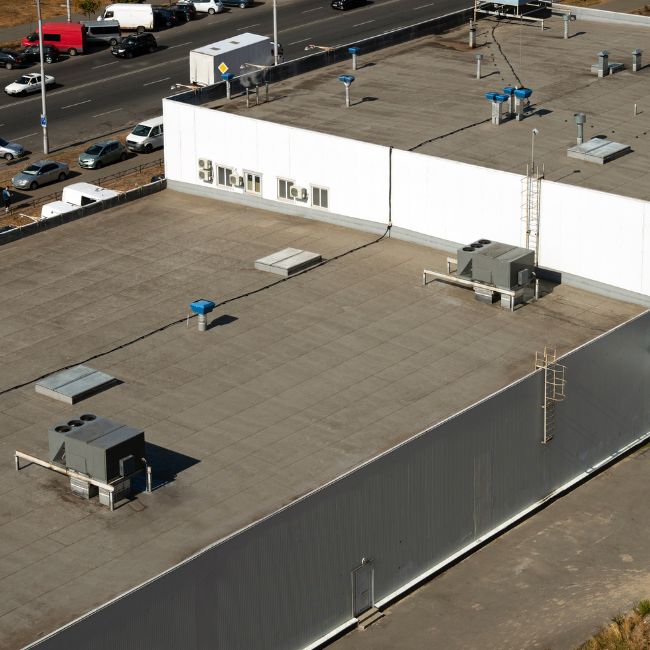
The common types of commercial roofing systems are single-ply membranes (TPO, EPDM and PVC), asphalt-based membranes (modified bitumen and built-up), metal panels, and coatings that renew a roof that’s still sound. Which one fits your building depends on slope, drainage, wind, sun and what sits on the roof, not on a brand name.
This guide explains each system, names the trade-off that comes with it, and walks through how to narrow the choice for a Northwest Florida building. It also covers industrial roofing and EPDM, which Rhino Roofing NWFL doesn’t list as services, so you can compare quotes fairly.
What a commercial building roof is made of
A commercial building roof is an assembly, not one material. FEMA’s hurricane handbook for public facilities lists the parts of a low-slope roof: framing, deck, insulation, covering, edges and parapet walls, drains, openings and rooftop equipment. Commercial roof construction stacks these layers, and the covering you pick is only the top one.
“Low-slope” means very little pitch. Pitch is rise over run, so 2:12 is two inches of rise for every 12 inches of run, and the 2023 Florida Building Code uses “less than 2:12” in its edge-metal and ballast rules.
Drainage matters just as early. The National Roofing Contractors Association (NRCA) defines ponding as water that stays in low spots more than 48 hours after rain, under conditions that favor drying. Ponding limits which coatings make sense, as you’ll see below, and FEMA notes that replacing a covering is a chance to fix it.
The main types of commercial roofing systems, side by side
Commercial roof types fall into single-ply membranes, asphalt-based membranes, metal panels and coatings. Membranes and asphalt systems suit low-slope roofs, metal depends on slope and seam type, and coatings only work on a roof in good enough shape. The Florida Building Code sets a minimum slope for each covering, so slope narrows the list before price does.
TPO roofing
TPO (thermoplastic polyolefin) is a single-ply membrane, a factory-made sheet rolled across the deck. The U.S. Department of Energy (DOE) notes TPO is typically white and reflects sunlight well, which matters in hot climates, where DOE says cool roofs save the most cooling energy. Membrane maker Carlisle SynTec describes its TPO as heat-weldable, meaning the seams are fused with heat, and lists three attachment methods: mechanically fastened, adhered and induction welded.
Attachment is where Gulf Coast buyers should ask questions. Carlisle says a fully adhered system provides the highest durability and wind uplift protection. That’s the manufacturer’s claim, so ask for the tested assembly behind any proposal.
The catch is chemicals. Roofing manufacturer Tremco’s chart rates TPO B for grease (suitable for most uses, with possible staining) and C for oils (suitable only for brief, intermittent contact), so a roof under kitchen exhaust needs a closer look. Rhino installs TPO roofing systems.
EPDM roofing
EPDM (ethylene propylene diene monomer) roofing is a synthetic rubber single-ply membrane. Membrane maker Elevate’s technical sheet for one RubberGard EPDM product (a low-slope fire-retardant type) describes a non-reinforced, cured membrane that can be ballasted, fully adhered or mechanically attached. DOE adds the Florida catch: EPDM is typically black, so it has to be formulated differently or coated to reflect sunlight.
Ballasted means held down with gravel, stones or pavers. FEMA warns that loose gravel ballast can become wind-borne debris, and in hurricane-prone regions it recommends replacing roof coverings that use gravel ballast or lightweight pavers. Elevate also says to isolate petroleum products, greases, oils and animal fats from the membrane.
EPDM isn’t on Rhino’s commercial service list, so this section is here to help you compare quotes, not to sell it.
Modified bitumen roofing
Modified bitumen is an asphalt-based membrane. The Asphalt Roofing Manufacturers Association (ARMA), a trade group, describes it as a base sheet and a cap sheet, a polyester or fiberglass mat coated with polymer-modified asphalt. ARMA publishes product data for APP-modified and SBS-modified versions, installed by propane torch or with cold adhesive, and says these systems are trusted to protect against weather, temperature extremes, impacts and foot traffic.
The weak point is the edges. FEMA says built-up and modified bitumen systems have shown good wind performance, provided the edge flashing or coping doesn’t fail, which it notes happens frequently. Ask how the edge metal will be attached and tested. Rhino also installs modified bitumen roofing.
Built-up roofing is the older layered cousin. DOE describes it as a base sheet, fabric reinforcement layers and a protective surface layer, and it isn’t on Rhino’s service list.
Metal roof panels
Metal comes in two main styles. Exposed-fastener panels are screwed through the face, so the fastener heads stay out in the weather. Standing seam panels attach with clips under raised seams, so no fasteners show, according to fastener maker SFS Group.
Slope limits the choice. SFS says exposed-fastener systems can’t go on a pitch below 3:12. The Florida Building Code lists 3:12 for lapped, non-soldered seam panels without lap sealant, 1/2:12 with applied sealant, and 1/4:12 for standing seam.
Each style has a trade-off. SFS notes exposed systems almost always cost less, but maintenance typically means replacing damaged fasteners, while standing seam failures are exceptionally difficult to repair. Near the coast, a U.S. Steel and DuPont release says coastal metal roofing must withstand the toll that wind and saltwater inflict over time, so ask any panel maker for its written coastal terms. Rhino’s service list includes exposed-fastener, Galvalume, 5V and standing seam metal roofing.
Roof coatings
A roof coating is a liquid applied over an existing roof. DOE says coatings can extend a roof’s service life as long as the roof is still in good condition. It lists three options for an existing roof: coat it, re-cover it, or tear off and replace it, and for a roof in poor condition or near the end of its life it says re-covering, replacing or retrofitting is usually best.
Coating type matters on flat roofs. Coating maker Gaco’s data sheet for its acrylic says it isn’t intended for slopes under 2:12 or surfaces prone to ponding, and it points to silicone for long-term ponding resistance. Gaco’s silicone sheet says that coating permanently withstands ponding water, and that it shouldn’t be recoated with acrylic, urethane or Hypalon. Those are one manufacturer’s terms, so read the data sheet for the product being proposed.
NRCA’s 2026 coatings guidelines cover preparation and on-site evaluation, so ask what was evaluated before any coating is priced. Rhino offers acrylic, silicone and elastomeric commercial roof coatings.
Industrial roofing: the same systems, harsher exposure
Industrial roofing isn’t a separate system. The Florida Building Code’s roof covering section is organized by material, such as built-up, modified bitumen, single-ply and metal panels, not by whether a building is commercial or industrial. What changes is the exposure: rooftop equipment, heavy traffic, grease and chemicals.
FEMA notes that poorly anchored rooftop equipment can shift and tear or peel the membrane, and it suggests mounting equipment on a curb or pedestal. For chemical exposure, Tremco says PVC (polyvinyl chloride) and KEE membranes are widely regarded as having the best chemical resistance among thermoplastics. PVC isn’t on Rhino’s service list. Tremco also notes its warranties exclude chemical attack, so ask any manufacturer for its exclusions in writing.
How to choose a commercial roof system for your building
Work through these in order. Each step removes options.
- Start with slope and drainage. Ask for the slope and any ponding to be documented before a system is named. The code minimums above rule systems in or out, and water that lingers past 48 hours changes which coatings and membranes make sense.
- Decide whether to coat, re-cover or replace. DOE’s three options depend on the roof’s condition today. If you replace, FEMA recommends removing the old covering down to the deck rather than re-covering, so the structure can be checked.
- Plan for wind at the edges and for how the membrane is attached. The Florida Building Code requires metal edge systems on built-up, modified bitumen and single-ply roofs under 2:12 to be tested to ANSI/SPRI ES-1 or RAS 111. FEMA flags mechanically attached and air-pressure-equalized single-ply systems as prone to degradation after debris impact and not recommended for hurricane-prone regions. That’s guidance for public buildings, not a code rule, so ask which tested assembly meets the wind requirement at your address. For the storm side, see wind damage to your roof.
- Match the surface to sun and humidity. DOE says reflective roofs save the most cooling energy in hot climates, and Northwest Florida summers are long and hot. It also says cool surfaces in warm, moist places can be more prone to algae or mold, which can reduce reflectance, so ask about algae resistance and cleaning.
- List what lives on the roof. HVAC units, vents, exhaust and service traffic change the details and the membrane, as the industrial section above explains.
- Compare lifecycle, not just the bid. DOE says to weigh upfront cost against the roof’s lifetime, maintenance, disposal and replacement. Bids differ most on roof size and complexity, the system, tear-off versus overlay, decking repairs found once the old roof is off, access, flashing, permits and warranty tier. Two bids aren’t comparable until the scope matches.
- Plan inspections before you need them. FEMA recommends inspecting a low-slope roof at least twice a year, ideally spring and fall, and after high wind events, then finishing repairs quickly. Rhino Roofing NWFL’s commercial roofing services include preventive maintenance and roof inspections.
Frequently asked questions
Is industrial roofing different from commercial roofing?
Not as a system. Industrial buildings use the same families of coverings, and the Florida Building Code sorts roof coverings by material. The difference is exposure to equipment, traffic, grease and chemicals, and those drive the membrane choice, so list them for any roofer you ask.
Can I coat a commercial roof instead of replacing it?
Sometimes. DOE says coatings extend a roof’s life only while the roof is still in good condition, and that a roof in poor condition is usually better re-covered or replaced. An inspection that checks condition and ponding decides which path fits.
How often should a commercial roof be inspected?
FEMA recommends at least twice a year, ideally spring and fall, plus after high wind events, with repairs completed quickly. Rhino Roofing NWFL lists preventive maintenance and roof inspections for commercial buildings.
Which commercial roof type is best for Florida?
No single type wins. Slope and drainage come first, then wind exposure at the edges, heat and humidity, and what the building is used for. A roofer or design professional should confirm a tested assembly for your address.
Ready to compare options for your commercial roof?
Slope, drainage, edges and the roof’s current condition decide what works, whichever system you’re leaning toward. Rhino Roofing NWFL (FL license CCC1337583) inspects and replaces commercial roofs from Pensacola to Panama City. Call (850) 999-7663 or request an inspection to start.