
License Number CCC1337583
Wind Damage to Your Roof
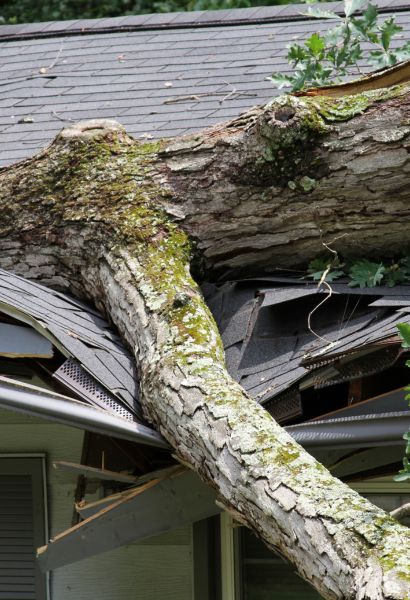
For wind damage roof repair, start with a look from the ground, then call a licensed roofer. Wind breaks the bond that holds shingles down, goes after the edges first, and leaves damage that’s easy to miss from the street. Photograph what you can see, protect the inside of the house and let a professional do the climbing.
You don’t need a hurricane for this. The National Weather Service counts thunderstorm winds of 58 mph or higher as severe, and the National Hurricane Center’s wind scale lists shingle and roof damage even for a Category 1 hurricane (74 to 95 mph sustained). This is general information as of October 2026.
How wind damages a roof
Asphalt shingles are held down two ways: nails, and a strip of factory adhesive that bonds each shingle to the one below. Wind gets under a tab and breaks that bond, which is called unsealing. A shingle that’s no longer glued down can flap, crease or tear away. The Insurance Institute for Business and Home Safety (IBHS) said in September 2026 that “unsealing of shingles remains the single greatest driver of wind vulnerability.”
Age matters too. In that study, most shingle products began losing wind resistance between years five and ten.
Edges go first. A U.S. Department of Energy-funded building guide says the greatest stress on a roof in high wind is at the roof edges, and most blow-off starts there. Those are the eaves (the lower edge) and the rakes (the sloped edges at a gable end).
Nails matter too. FEMA’s Hurricane Michael recovery advisory (June 2019) points to unsealed or partly unsealed shingles and misplaced nails as likely contributors to poor shingle performance. It also describes a Panama City-area house that, according to the homeowner, lost only its ridge shingles and ridge vent (at the roof’s peak), yet had ceilings collapse in several rooms from the rain that got in.
Once the covering goes, the underlayment (the water-resistant layer under the shingles) is the only barrier left, and then the decking, the plywood or OSB boards beneath, gets wet. FEMA says several of its assessment teams found wind damage to the roof covering to be a primary source of water getting into homes.
Wind damage to a roof: what you can see from the ground
All of this shows from the ground or in a zoomed phone photo. NRCA, the National Roofing Contractors Association, says owners should inspect only from ground level because the risk of falling is too great. Look for:
- Shingles, pieces of shingle or metal in your yard or the neighbors’
- Bare or darker patches where shingles are gone, or a crooked, uneven roofline
- Tabs that look lifted, curled or creased, especially along the eaves and rakes
- Bent, loose or missing drip edge (the thin metal strip along the roof edge that directs water off), a shifted vent or loose metal around the chimney
- Water stains or damp spots on ceilings and walls
Some wind damage can’t be judged from the ground, such as lost seals or loosened fasteners. NRCA says an inspection should confirm roof areas are still sealed and attachments still secure, and it recommends inspecting all roofs in a storm’s path, regardless of appearance. Hail has its own guide: hail damage to your roof.
Safety comes first. The National Weather Service warns that power lines on the ground may be live, so don’t go near them. If a ceiling sags, walls look shifted or the roofline has dropped, stay out until a qualified building inspector or structural engineer checks the house. Ready.gov gives that advice when a building’s safety is in doubt.
What wind ratings and the Florida Building Code mean
Shingle packages carry a wind class from one of two tests, according to ARMA, the asphalt shingle manufacturers’ trade group (November 2025). ASTM D3161 runs a fan over a shingle deck for two hours, and the highest speed reached without any shingle lifting sets the class (Class F is the top). ASTM D7158 measures uplift resistance, combining adhesive bond and shingle stiffness (Class H is the top), and its results can be compared with code design wind speeds.
A class letter isn’t a guarantee. IBHS found every product in its 10-year study carried the highest wind classification under current standards, yet performance after aging differed dramatically.
The Florida Building Code sets the minimum. The 8th Edition (2023) has been in effect since December 31, 2023, and its wind criteria follow a national engineering standard, ASCE 7-22. The Florida Building Commission says design wind speeds rose in the western Panhandle for homes and most other buildings. A 9th Edition (2026) is in development, so ask your building department which edition applies to your permit.
Some owners build beyond that minimum. FORTIFIED Roof is a voluntary IBHS program that asks for a sealed roof deck, a wider drip edge, a fully adhered starter strip (the first row along the edge) and ring-shank nails in a tighter pattern. The trade-off is extra materials and steps, so decide before the old roof comes off.
What to do after wind damage
The full checklist is in what to do about storm damage to your roof. For wind:
- Wait until the weather has passed and officials say it’s safe. Stay clear of downed lines.
- Walk around the outside and photograph what you can see. Florida’s Homeowner Claims Bill of Rights (s. 627.7142) advises taking photos or video before and after any repairs.
- Protect the inside. Move belongings from under drips and stay out of a room with a sagging ceiling.
- Call your insurer before you sign a repair contract, as the Bill of Rights also advises.
- Call a licensed roofer. If the roof is open to rain, ask about a tarp, and read temporary vs. permanent roof leak repair for what a tarp does and doesn’t solve.
Wind damage roof repair: what a roofer checks, and repair or replace
A wind inspection looks past the missing shingles. A roofer checks the edges, ridge, flashing and vents, whether shingles have lost their seal, whether fasteners are secure and whether water reached the deck. ARMA (February 2026) lists replacing shingles damaged by windborne debris and resealing shingles damaged by high winds among typical repairs.
Repair or replace depends on how widespread the damage is, how old the roof is and what’s under it. A few lost shingles on a sound roof can be a targeted repair. On an older roof, replacing the missing ones fixes the hole you can see, not shingles that lost their seal elsewhere. An honest roofer says which situation you’re in.
Rhino Roofing NWFL’s storm damage repair services include Roof Inspections & Insurance Reports, Emergency Roof Tarping, and Asphalt Shingle Roof Repair and Replacement. Before you hire, ask:
- How do you check whether shingles have lost their seal? Missing shingles are only part of it.
- Can I see photos of the edges, ridge and flashing?
- If the roof comes off, how will you check the deck attachment, and what underlayment goes on?
- What’s your Florida license number? Verify it yourself on the state’s license lookup.
Wind, hurricanes and insurance: general information as of October 2026
Whether wind damage is covered depends on your policy, and Florida treats hurricane wind separately. Under s. 627.4025 of the 2026 Florida Statutes, the hurricane period starts when the National Hurricane Center issues a hurricane warning for any part of Florida and ends 72 hours after the last hurricane watch or warning ends.
Notice has a deadline too. Under s. 627.70132, notice of a claim is due within one year after the date of loss, and notice of a supplemental claim within 18 months. For a hurricane, the date of loss is landfall, and for other windstorms it’s the date NOAA verifies the event. Policies can differ, so confirm specifics with your insurer or a licensed professional.
Wind damage questions homeowners ask
How much wind does it take to damage a roof?
The National Weather Service treats thunderstorm winds of 58 mph or higher as severe, and IBHS says shingles have failed at wind speeds below design levels. For scale, the National Weather Service in Mobile recorded a 92 mph peak gust at NAS Pensacola during Hurricane Sally in 2020.
Can wind damage be repaired without replacing the whole roof?
Often, yes. Limited damage can be a targeted repair, such as replacing lost shingles or resealing lifted ones.
Does homeowners insurance cover wind damage?
It depends on your policy, the cause of loss and your deductible, and no one can promise a claim will be paid.
Wind damage on your roof in Northwest Florida?
Rhino Roofing NWFL (Florida license CCC1337583) handles storm damage roof repair in Pensacola, Gulf Breeze, Navarre, Milton, Pace, Crestview, Fort Walton Beach, Destin, Panama City and nearby communities. Rhino is GAF Certified for asphalt shingle installation. Call (850) 999-7663 or use the button below.