
License Number CCC1337583
TPO Roofing for Commercial Buildings
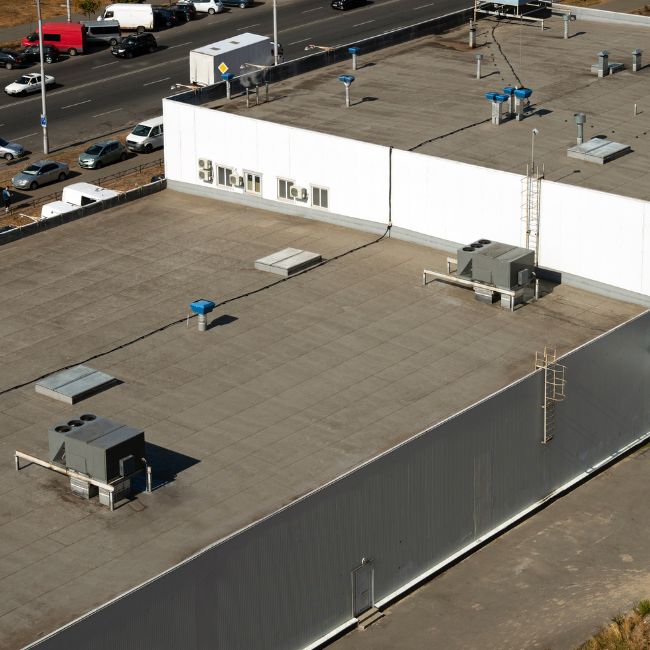
TPO roofing is a single-ply membrane, heat-welded at the seams, made for flat and low-slope commercial roofs. Single-ply means one layer of factory-made sheet instead of layers built up on site. TPO’s selling points are reflectivity and fused seams, and its weak spots sit in the same places: seam quality depends on the installer, and TPO products are not all equal. Here is how it goes on, where it fails, and what to put in writing before you sign.
What is TPO roofing, exactly?
TPO (thermoplastic polyolefin) is a factory-made, fabric-reinforced sheet that serves as the waterproof layer on a low-slope roof. “Thermoplastic” means it softens when heated and rehardens when cooled, so installers can weld overlapping seams with hot air instead of gluing them.
Professional Roofing, NRCA’s magazine, says heat-welding produces an impermeable surface that increases leak protection. “Low-slope” means a pitch of 2:12 or less (2 inches of rise per 12 inches of run), the definition used in ENERGY STAR’s now-retired roof products specification.
ASTM D6878 is the material standard for TPO sheet. It requires reinforcing fabric or scrim and sets minimum quality limits, but it excludes in-place criteria such as field seam strength. A membrane that meets it still depends on a sound installation.
How a TPO roof is attached
Two common attachment methods are worth knowing. Mechanically attached means fasteners and plates hold the sheet to the deck at set points. Fully adhered means the sheet is bonded across its whole surface. Carlisle SynTec, a single-ply manufacturer, calls mechanically attached a popular, economical system for areas with moderate winds, and describes fully adhered as the option with the highest stability and uplift protection.
Florida adds a code layer. One Florida product evaluation report for a TPO system, written to the 2010 Florida Building Code, requires the selected assembly to meet or exceed the design wind pressure calculated under Chapter 16 of that code. In plain terms, the wind rating belongs to the tested assembly, not to the membrane alone. Code editions and product approvals change, so confirm current requirements with the building department or a licensed professional.
Why Florida heat makes “reflective” matter
Solar reflectance is the share of sunlight a roof bounces back, on a scale of 0 to 1. Thermal emittance is how well the roof sheds the heat it does absorb. The EPA calls reflectance the most important characteristic and says high emittance also plays a role in hot, sunny climates.
EPA retired the ENERGY STAR roof products program in 2022, but its old Version 2.2 specification still shows what “cool” used to mean for low-slope products: an initial solar reflectance of at least 0.65, and at least 0.50 three years after installation. The second figure is the aged value, measured after three years. Roofs get dirty, and the EPA lists periodic cleaning among the ongoing costs of a cool roof, especially a low-sloped one.
ENERGY STAR’s roof guidance, from before the program ended, cited Lawrence Berkeley National Laboratory: on a typical summer afternoon, a white roof reflecting 80% of sunlight stays about 50°F cooler than a gray roof reflecting 20%. Ratings are product-specific, though. Ask for the rated values of the exact membrane, from the Cool Roof Rating Council’s rated product directory.
Where TPO roofs go wrong
TPO has four trade-offs worth knowing before you choose it.
Seams depend on the installer. Heat-welded seams hold up when they are welded well. A Western States Roofing Contractors Association field study of 60-mil TPO from four manufacturers, summarized in Professional Roofing in 2014, reported no issues with seam integrity. It tied the one membrane that cracked to a sharp crease made during the original installation.
Products vary. A 2017 Professional Roofing article notes that TPO is a newer material and that formulations offer varying levels of durability. The 2014 article, by two GAF authors, found large disparities among manufacturers’ membranes: “TPO membranes are not all equivalent.” A quote that just says “TPO” is not specific enough.
Ponding water. NRCA defines ponding as water that stays in low spots more than 48 hours after rain, under conditions that allow drying. Its Roofing Manual, quoted in Professional Roofing, says ponding beyond 48 hours can be detrimental to the roof assembly, while short-term ponding is unavoidable and acceptable. Drainage is a design question, so settle it in the scope, not after the first storm.
Foot traffic and punctures. GenFlex, a TPO manufacturer, recommends walkway pads at every roof access point, along routes walked more than once a month, and around rooftop equipment that needs periodic service. Its data sheet also says not to put pads over seams.
How TPO compares with EPDM, PVC and modified bitumen
SPRI, the single-ply industry association, says single-ply makes up the vast majority of the low-slope commercial market in North America. Within that group, the seam method is the dividing line. TPO and PVC are thermoplastics seamed with hot-air welders. EPDM is a thermoset rubber, and SPRI says its seams are joined with pressure-sensitive tape.
Modified bitumen is a different family of membrane. Rhino Roofing NWFL installs it too, and the guide to types of commercial roofing systems lays out how the options differ.
What to ask a contractor and what belongs in a written scope
Two TPO quotes are only comparable if both name the same things. Ask for these in writing:
- The manufacturer, product name, membrane thickness and attachment method.
- The Florida product approval for the full assembly, and the wind design pressure it must meet.
- The rated reflectance of the exact membrane.
- How seams will be welded and checked, and how flashing is handled at penetrations, curbs and roof edges.
- How the plan deals with low spots where water now stays past 48 hours.
- Walkway pads at access points and around equipment.
- An allowance for damaged insulation or decking found once the old roof is open.
- The manufacturer’s warranty and the contractor’s workmanship warranty as two separate documents, with the actual terms in hand.
That list is also what drives the cost: the system and thickness, the attachment method, the condition of the insulation and deck, drainage fixes, flashing complexity and permits. The scope shows which of those a quote includes.
Maintenance and inspection
Professional Roofing says inspections matter whatever the membrane, and that leaks can go unnoticed. On TPO, an inspection should cover seams, flashing, punctures near equipment, walkway pads, and any water still standing 48 hours after rain. Reflectance drops as a roof gets dirty, so ask whether cleaning belongs in the plan. Leave roof access to a professional.
Frequently asked questions
Is TPO right for every commercial building?
No. TPO is made for low-slope roofs, but the fit depends on drainage, foot traffic, wind design pressure and the specific product. A written scope that names the product and attachment method is how you compare it fairly with other systems.
How long does a TPO roof last?
No single figure applies, because it depends on formulation, installation, drainage and upkeep. Professional Roofing reported in 2014 that more than 4 billion square feet of TPO had been installed, and that some prematurely failed systems involved earlier formulations or suppliers that have since left the business. Ask for the written warranty on the exact product.
What is the difference between TPO and PVC?
Both are thermoplastic membranes seamed with hot-air welders. They are different formulations, so compare the specific products’ data sheets. If PVC is on your list, ask each bidder to confirm they install it.
Planning a TPO roof for your commercial building?
Rhino Roofing NWFL installs TPO roofing systems for commercial buildings in Pensacola, Gulf Breeze, Navarre, Milton, Pace, Crestview, Fort Walton Beach, Destin, Panama City and nearby communities. Rhino also offers commercial roof inspections and preventive maintenance (Florida license CCC1337583). Start with the Commercial Roofing page, or call (850) 999-7663 to talk through your roof.