
License Number CCC1337583
What to Do About Storm Damage to Your Roof
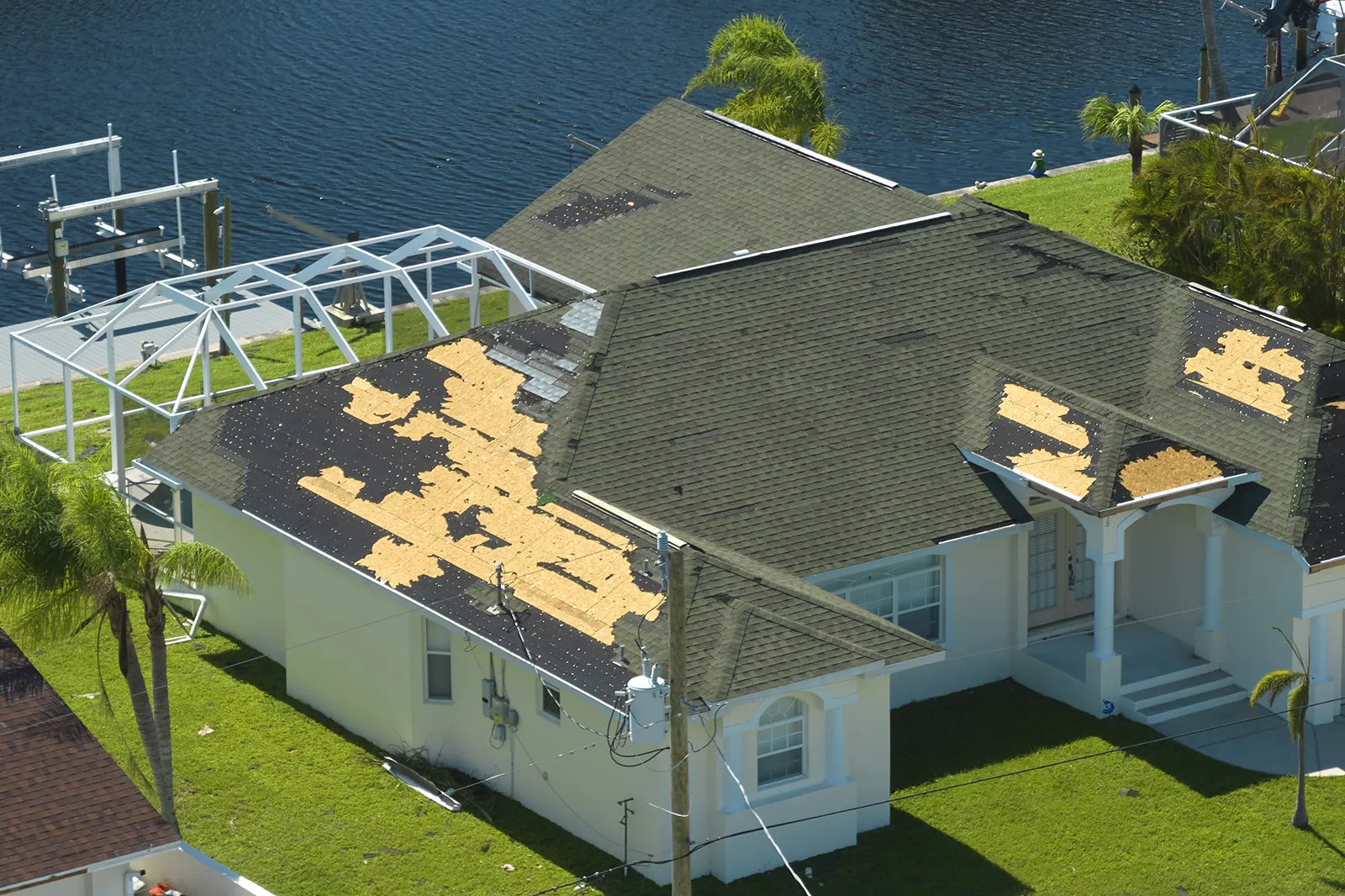
After storm damage to your roof, stay off it and work from the ground and the inside of the house. Photograph what you can see, keep water away from your belongings, report the claim to your insurer, and have a licensed roofer inspect before you sign any repair contract.
The Atlantic hurricane season runs June 1 to November 30 and peaks around September 10, according to the National Hurricane Center. Everything below is general information as of October 2026, not legal or insurance advice.
What to do in the first hours after storm damage to your roof
Wait until the weather has passed and local officials say it’s safe. Then work from the ground and from inside the house: photograph the damage, move belongings away from leaks, report the claim, and call a licensed roofer. Never climb up to look or patch anything yourself.
- Check for danger first. Stay well away from downed power lines and from standing water they may have charged. Report fallen lines to the police, and call 911 if anyone is in immediate danger.
- Look from the ground. Note shingles, metal or debris in the yard and branches on the roof. The National Roofing Contractors Association (NRCA) says owners should inspect only from ground level, because the risk of falling is too great.
- Photograph before you clean up or repair. Take wide shots and close-ups, inside and out. Label photos by room, keep damaged materials when it’s practical, and save every receipt.
- Protect the inside. Move furniture away from drips and set out containers. If a ceiling sags or bulges, stay out of that room and call a professional. Our guide on what to do about a leaking roof covers the indoor steps.
- Call your insurer. Submit the claim directly to your insurer, and ask about any repair rules before you sign a repair contract. Florida’s Homeowner Claims Bill of Rights (s. 627.7142, Florida Statutes) advises both.
- Call a licensed roofer. Ask for an inspection, and for protection if the roof is open to rain.
Temporary protection or permanent roof storm damage repair
Temporary protection usually means a tarp, a waterproof sheet fastened over the damaged area to keep rain out. It buys time. It doesn’t repair torn shingles, damaged flashing (the metal that seals joints around vents, chimneys and valleys) or soaked decking (the plywood or OSB boards under the shingles).
Florida’s Homeowner Claims Bill of Rights advises you to make and document the emergency repairs needed to prevent further damage, and to keep the receipts. Whether your policy pays for them is a question for your insurer.
Permanent repair comes after an inspection shows what the storm did, which can range from replacing a few shingles to replacing the roof. Rhino Roofing NWFL offers Emergency Roof Tarping, Roof Leak Repair, Asphalt Shingle Roof Repair and Replacement, and Water Damage Mitigation from Roof Leaks. See the Storm Damage Repair page for more.
How wind, debris and water cause roof damage from a storm
Storm damage to roof edges deserves a close look. FEMA’s hurricane mitigation handbook says the roof border (the eaves, the sloped rake edges at a gable end, and the edge metal) is more at risk from wind uplift and wind-driven rain than the rest of the roof. Age matters too: the Insurance Institute for Business and Home Safety (IBHS) said in April 2026 that aging asphalt shingles can fail at wind speeds well below hurricane force.
Flying debris can puncture the roof covering. Once shingles are gone or torn, rain reaches the underlayment (the water-resistant layer under the shingles) and then the decking. FEMA’s field teams after Hurricane Michael in Florida noted roof covering damage from high winds as a primary source of water intrusion.
Hurricane Sally in 2020 produced gusts of 92 mph at Naval Air Station Pensacola, the National Weather Service in Mobile reported.
Roof damage from storm hail looks different, so it has its own guide: hail damage to your roof. For more on wind, see wind damage to your roof.
Signs of a storm damaged roof you can spot from the ground and inside
Look for:
- Shingles, pieces of shingle or roof metal in the yard
- Bare patches, an uneven roofline or shingles that look lifted from the street
- Bent or missing metal along the roof edges or around vents and the chimney
- Branches or other debris resting on the roof
- Water stains, drips or damp spots on ceilings and walls
A stain can show up feet away from where water got in, because water travels along the decking and framing first. Some damage can’t be seen from the ground at all. That’s why NRCA has recommended inspecting every roof in a hurricane’s path, whatever it looks like, and why a roof that looks fine can still be a damaged roof.
How to vet a storm damage roofing contractor and spot a storm chaser
A storm chaser is a contractor who follows disasters from town to town, often without a local address. The knock on your door isn’t the tell, since legitimate local roofers knock too. The pattern is. Watch for:
- Pressure to sign today. A real estimate can wait.
- Offers to waive or cover your deductible, or cash, gift cards or other rewards for an inspection or a claim. Florida bars contractors from this (s. 489.147).
- Talk about what your policy covers, or an offer to negotiate with your insurer. A contractor can’t interpret your policy or adjust your claim unless licensed as a public adjuster, the state-licensed role that can negotiate a claim for a fee (s. 489.147).
- A request to sign over your claim payment. For residential policies issued on or after January 1, 2023, Florida makes assigning post-loss benefits (signing your claim payment rights over to someone else) void, with limited exceptions (s. 627.7152).
- Cash only, large upfront payments or a lump-sum number. Florida’s emergency management guidance says never to pay cash in full before the work is done and to get itemized written estimates.
Then run four checks:
- Look up the license at MyFloridaLicense.com, run by the Department of Business and Professional Regulation. An occupational license is only a local tax receipt, not a contractor license. You can look up Rhino’s license, CCC1337583, the same way. Unlicensed contracting during a declared state of emergency is a felony (s. 489.127).
- Ask for proof of insurance before any work starts, as s. 627.7142 advises.
- Get more than one itemized written estimate, and be skeptical of the lowest bid, as NRCA advises.
- Know your cancellation window. If you sign a roof repair or replacement contract within 180 days of an event covered by a governor’s state of emergency declaration for your area, you can cancel without penalty within 10 days or by the official start date, whichever comes first (s. 489.147).
What happens at a roof inspection after a storm
NRCA describes a storm inspection as checking whether areas are tight, whether attachments are secure and whether debris has caused damage. A thorough one also looks at flashing, vents and pipe penetrations, where leaks often start, and at signs of water reaching the deck.
Dated photos and written notes of what was found, and where, are the record you’ll hand to your insurer. Rhino Roofing NWFL offers Roof Inspections & Insurance Reports. Ask any roofer what the report will include before the inspection.
Insurance basics for roof storm damage (general information, October 2026)
Coverage depends on your policy: the cause of loss, your deductible, and whether the roof pays at replacement cost value (the cost of new materials) or actual cash value (replacement cost minus depreciation). A storm doesn’t guarantee a claim is paid.
Florida sets a notice deadline. Under s. 627.70132 of the 2026 Florida Statutes, notice of a claim must reach your insurer within 1 year after the date of loss, and notice of a supplemental claim, meaning additional damage from the same storm, within 18 months. For a hurricane, the date of loss is the day it made landfall. The section was amended in 2022 (ch. 2022-271, effective December 16, 2022), so check the current text rather than older advice.
Your policy has its own notice terms too, so report promptly. For anything specific to your policy, ask your insurer, the Florida Department of Financial Services or a licensed professional.
Repair, replacement and storm damage restoration roofing
Storm damage restoration roofing usually runs in two phases: stop the water now, then rebuild what the storm broke. A limited area may be a repair. Widespread damage on an old roof may not be.
The call depends on how widespread the damage is, the roof’s age and condition, the state of the decking and what’s been repaired before. Hidden decking damage often can’t be priced exactly until the old roofing comes off, so a written estimate should say how decking repairs will be handled.
Storm damage roof questions
How long do I have to report roof storm damage to my insurer?
Under s. 627.70132 of the 2026 Florida Statutes, notice of a claim is due within 1 year after the date of loss, and notice of a supplemental claim within 18 months. Your policy may set its own terms, so call your insurer promptly.
Should I wait for the insurance company before getting a tarp?
Florida’s Homeowner Claims Bill of Rights advises making and documenting the emergency repairs needed to prevent further damage. Photograph first, keep receipts, and ask your insurer how your policy treats the cost.
Can a roofer handle the claim with my insurance company for me?
A roofer can inspect, document and repair. Under s. 489.147, a contractor can’t interpret your policy, advise you on coverage or adjust your claim unless licensed as a public adjuster.
Dealing with a storm damaged roof?
Rhino Roofing NWFL offers roof inspections, Emergency Roof Tarping, and storm damage roof repair, including asphalt shingle repair and replacement, in Pensacola, Gulf Breeze, Navarre, Milton, Pace, Crestview, Fort Walton Beach, Destin, Panama City and nearby communities (Florida license CCC1337583). Call (850) 999-7663 to talk through your roof.